

Adventures in de-socialisation
Society as war

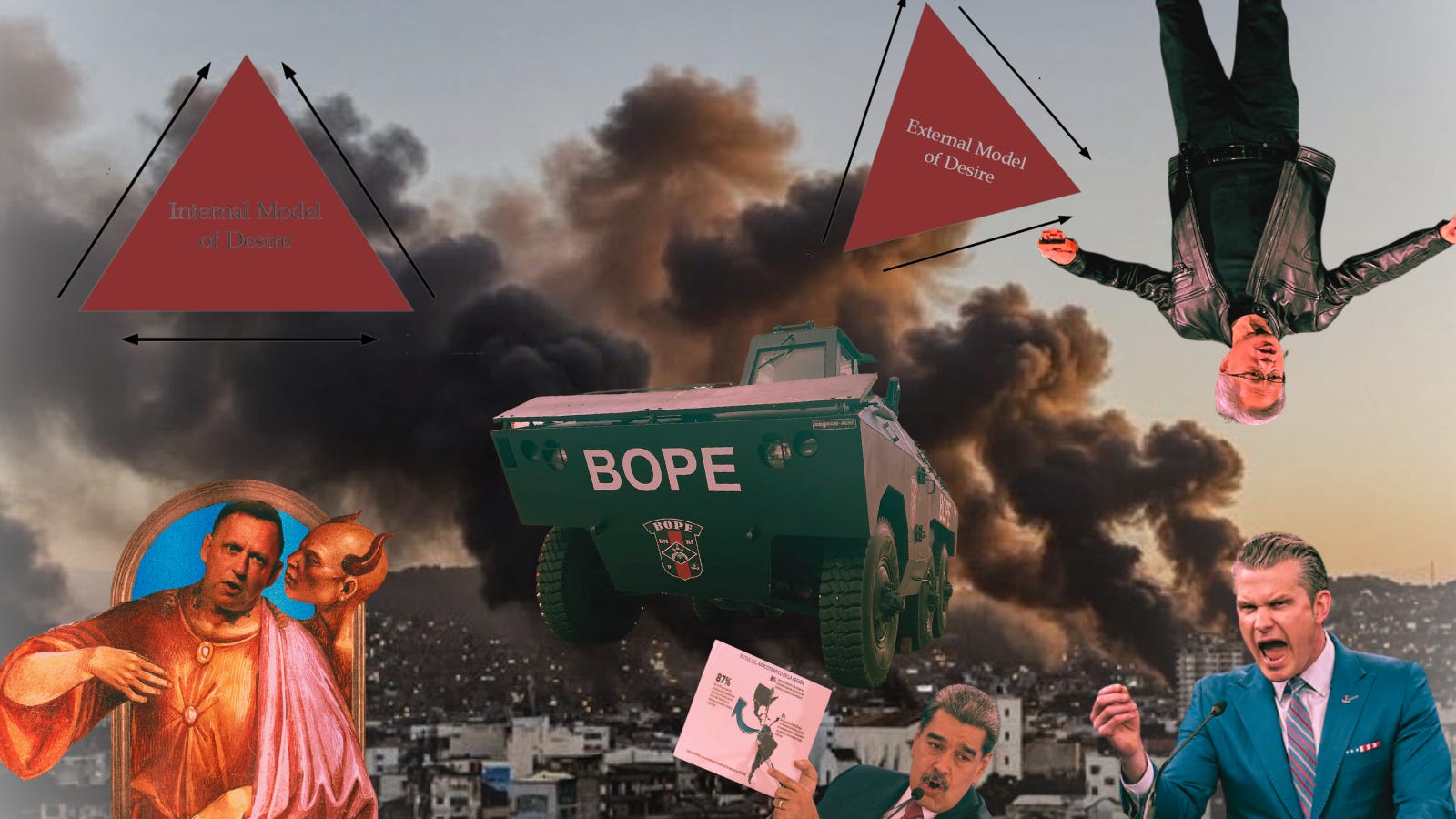
It’s tempting to catalogue the world’s “adventures in de-socialisation” on a monthly basis. Maybe it’s that what is in front of me that shapes this: a police massacre in Rio de Janeiro that killed 130 – the largest in the country’s history – in an operation against the large Red Command drug trafficking organisation. Many of these were seemingly executed, not just killed in a firefight. Though there was also that, with the gang using drones to drop bombs on the police.
The Left lacks a convincing answer to public security problems or the growth of territories beyond state control. In response to massacres, justified lamentations over barbarisation are joined to “human rights” and “jobs and opportunities”. The Right only wants to intensify the situation and talks of implementing a ‘Bukele solution’ (we keep linking to our episode on this, but it’s not insistence on our part – it’s the world that keeps talking about it). All the while, society becomes increasingly war-like.
Though less violent, conditions in the core seem to feature more accentuated forms of de-socialisation and, indeed, less organic solidarity. On Bungacast we’ve long underlined the importance of creating the conditions for politics. Part of that is intellectual, sure, but another part is institutional. Politics today polarises between liberal-technocratic institution-maintainers and conservative-populist institution-destroyers, when the task surely lies just as much in institution-building or institution-creation. One of the difficulties encountered in all this this is that there is evidence that shows that those most charged with the necessary burn-it-down energy are also those most mistrustful of fellow citizens. Which is why a febrile situation is not a revolutionary one, and why tear-it-down struggles to feed into build-it-anew.
All this rests on a social substrate that appears to be rapidly subsiding. Politics is important it rests on the pre-political (on this, see the next print issue of Damage). Society must be defended – to take the title of a collection of Michel Foucault’s lectures. But Foucault meant to capture an irony: that the defense of society became a rationale for exclusion and destruction, underpinning modern regimes of biopolitics. A further irony is that responsibility for de-socialisation could, in part, be put at the foot of Foucault’s followers. It is their antinomianism, their hostility to norms, rules, and moral boundaries, that undermined the possibility of moral judgement or shared social understandings. Of course, in retrospect, they were only tailing and providing intellectual cover for marketisation and its effects.
Regardless of exactly how we apportion responsibility, maybe society really does need to be defended, for real this time. The alternative is a world made of inhuman and anti-human forces, isolated and fragmented individuals, and the reductive alibi that is now used to explain everything: culture (or worse, race).
It is with these thoughts in mind that I happily received an issue of Arch+ magazine containing what purports to be a catalogue of “modern wonders of the world”. What particularly piqued my interest were the following provocations found therein (I paraphrase): The critical project of Enlightenment now faces a new question: what happens when the process of deconstruction (that is, of challenging authority, norms, institutions) knows no bounds? When individualism detaches itself completely from societal orders? Perhaps autonomy no longer serves emancipation but threatens the foundation of social order?
This all gets filtered through matters pertaining to the built environment and ultimately architecture. Perhaps more attention needs to be paid to ritual, to being-here-together, to collective pause. As our guest Pier Paolo Tamburelli argued…
Tamburelli’s project is more about cataloguing what exists than necessarily arguing that something specific should happen in society or in architecture. In the face of neo-trads asking where the modern cathedrals are, he says: just fucking look.
This forms a nice pair with the episode that kicked off this month that likewise asked questions about how we live together, but in a decidedly more urban register: how we have adapted to the world of expressways.
There will be plenty more on the intersection of the questions of urbanism, place, and sociability next month (see below).
But for now: we can and should go further in thinking through what defending – and rebuilding – society requires, against anti-social socialists, dried-out neoliberal corpses, and lizard-brained rightists.
Here's what’s coming up in November
There is a decline in literacy across the West; and it goes beyond just knowing how to read. The causes are deeper than just “smartphones”. C Derick Varn, poet and English teacher, joins us to discuss.
Branko Milanovic will be on the podcast, talking about his new book of essays, The World Under Capitalism.
Delayed from last month, we’re going to be finishing up the Reading Club block on the middle class finishes up by looking at C. Wright Mills’ White Collar nearly 75 years on – with the participation of Dustin Guastella.
And do local scenes still exist? Are big cities distinct places any more or just homogenous sites for real estate speculation? What is ‘public’ in public space? We’re launching our multipart series on the future of place.
To get all episodes in full, you'll need to…
ICYMI in October
We are stumbling out of neoliberalism, towards state capitalism. In an important episode on the contemporary direction of capitalism, Ilias Alami explained how the state’s crisis-fighting measures are testament to capital’s weakness.
‘Big Man’ cities of midcentury built massive expressways for cars. What should we do about them now? Tearing them down seems to lead to sanitised and gentrified cityscapes. Richard Williams looks at how we’re learning to live in the expressway world.
Twenty years ago France suffered two key events: a constitutional coup when, after rejecting in a referendum a Treaty establishing a Constitution for Europe, one was imposed anyway; and massive riots exploded in the banlieues. With Fred Lyra, we retraced France’s passage through the End of History to the End of the End of History – and the way a ‘second periphery’ has asserted itself on the French stage.
From the Archives:
Flashback to our discussion with 2020 Pulitzer Prize winner Benjamin Moser on the tensions between hating your national culture and wanting to leave it behind, and the effacement of national culture by postmodern homogenisation. Also: Brazil, USA, literature, architecture, sex, imperialism, Freud, the image and representation, and contemporary wokeness.
