

Civilisation is a normative question
Or it is nothing at all. Civilisational rhetoric is back, and it's worse than ever.

“I also think that we have to avoid overlearning the lessons of the past. Just because one president screwed up a military conflict doesn’t mean we can never engage in military conflict again.” – JD Vance.
As I sat down to finish off this newsletter, in which I planned to write something or other about change versus continuity in US foreign policy, I saw that Trump had started bombing Iran overnight. JD Vance’s lame attempt to square MAGA antiwar stances and Trumpian reality seems to suggest continuity is the order of the day.
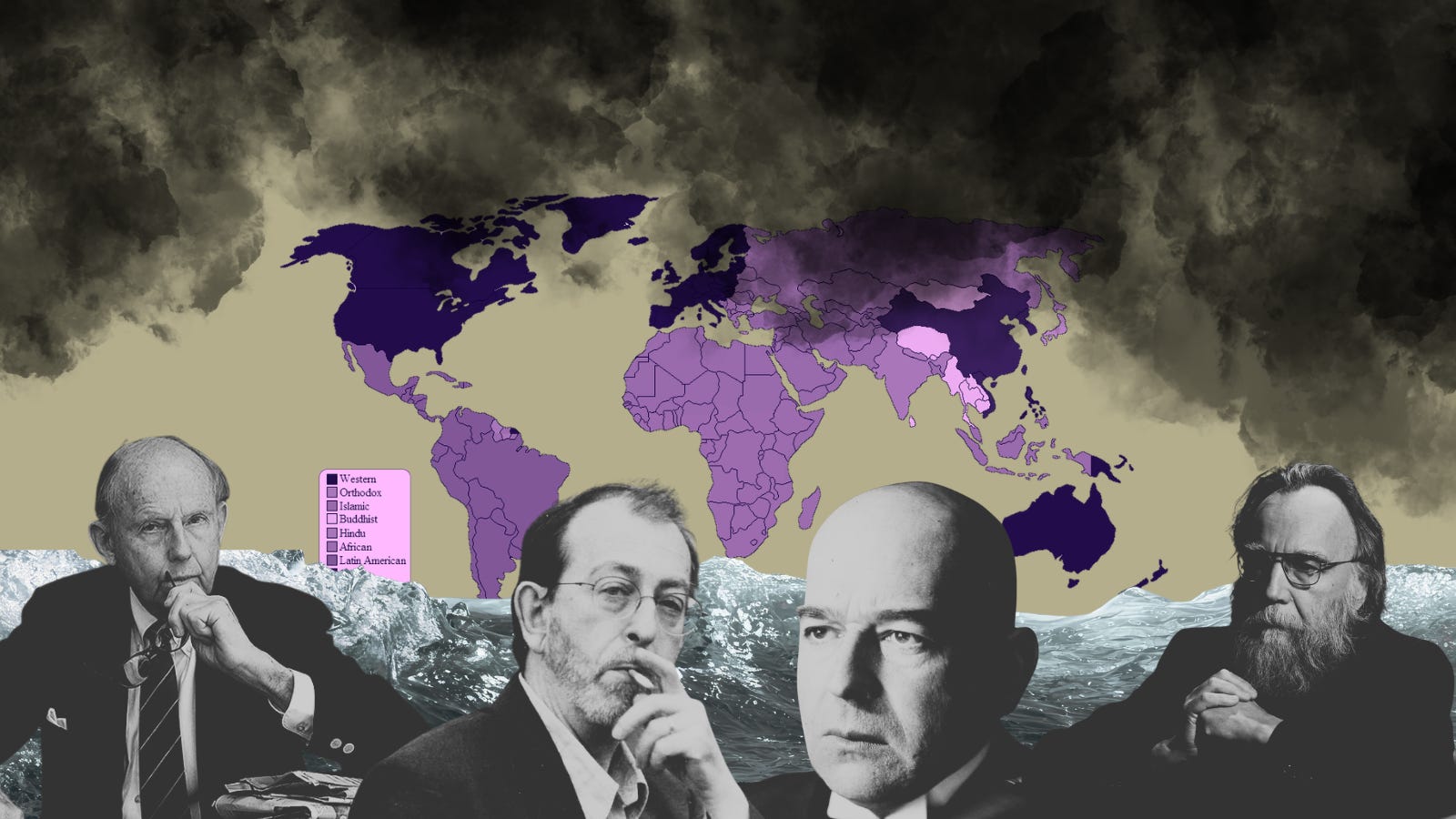
After January’s abduction of Maduro and the jiggery-pokery over Greenland (not to mention threats to Mexico and Colombia), we dedicated a good chunk of our February programming to try to understand the ideological roots of this aggression and chauvinism (see below for JF Drolet on paleocons; Juan Rojas on the Donroe Doctrine; and the Reading Club on illiberalism). The way some put it, Trump represented a backlash against liberalism across the board; in international affairs this would play out in a return to realism, in part influenced by paleoconservative thought.
As JF Drolet explained, this would be a populist realism.
Importantly, this doesn’t necessarily cash out in a renewed respect for sovereignty. Between internationalism and isolationism, there is a third option: civilisationalism. The correlate to the claim that there is no common globality under liberalism is that civilisations are deeply divided by history, spiritual commitments, even epistemology.
How new is all this? When we listen to Marco Rubio’s speech at Munich and witness the “massive and ongoing operation to prevent this very wicked, radical dictatorship from threatening America and our core national security interests” – as Trump has characterised his bombing of Iran – it feels like there may be a portal running from 2006 to 2026. Back then, it was neoconservative rhetoric about the West versus a barbaric terroristic Islam, Huntington’s clash of civilisations being read and discussed everywhere, conflict framed in Manichaean terms, etc. Today we have narco-terrorism, because when war on drugs doesn’t hit as it once used to, and war on terror is old hat, why not just combine the two into a mega-enemy?
The supposed return, at end of the End of History, of national interest, balance of power, sovereignty, etc is nowhere to be seen. Instead, as Michael C. Williams recently noted, Trump’s strategy “opens up new tactics unconstrained by norms of sovereign noninterference, such as overt support for, or contact with, civil society actors and political parties ideologically aligned with the current administration.” The result is a “diplomatic strategy that skirts the traditional boundaries of sovereign noninterference at the same time that it calls for more assertive (civilizational) sovereignty.”
Some have depicted the tension between paleoconservatism and neoconservatism as a clash between personnel in the Trump administration (figures like Bannon, Vance, Miller versus Marco Rubio). But maybe we are seeing a sort of a fusion between them in practice – rather like the seemingly incompatible neoconservatism and neoliberalism fused in US power in the 2000s.
Civilisationalism may offer elites more wears on an old shirt, especially for those of the centre and right. In our Letters to the Editors episode, we discussed a comment by listener and friend of the pod, Szilard Pap, in which he argued that “the entire civilisational paradigm is well-suited to papering over the rupture within the Atlanticist framework. From a European perspective it can be used to argue that, although Washington is now demanding greater subservience and more contributions to the maintenance of US hegemony, it is still worth it—otherwise we will all be ‘greatly replaced’ by Muslims and others.”
Thus populist nationalism can be reconciled with Europeanness. For the right, this civilisational conception of self can be understood as rooted in Christianity (even if not particularly pious); for the far-right, it is done in explicitly in racial terms. As I’ve argued before, when figures like Meloni identify the European legacy with Greek philosophy, Roman law and Christian ethics, what is flagrant in its absence is the Enlightenment (precisely the part of the European legacy worth fighting for). Here is where they may be a “left” wing of civilisationism too: didn’t Pim Fortuyn show the way 25 years ago, defending Europe precisely in liberal Enlightenment terms? Here we respect gays and women, unlike those barbaric Muslims…
In this way, for all the contemporary upheaval in US-Euro relations, and in the ideological bases of legitimation, we end up finding a path to continuity. Or rather, existing elites are able to adapt to the new disposition just as the populist counter-elites conform to existing structures – all under the aegis of civilisationism.
This is unlikely to be hegemonic, though. As Lee Jones pointed out in the Letters to the Editors episode, this vision is not able to offer the masses anything in political-economic terms. What it does have, as I argued in the same episode, is ideological gruel, most of it in the form of critiques of hyperliberalism.
A recent reading of Fukuyama’s end of history is emblematic in this regard – and also demonstrates the way “the end of the end of history” has now become a trope a decade on from our initial conversations on the subject, manipulated and put to serve very different political ends. As an essay in American Affairs has it:
The West is in chaos precisely because it listened to clichés put into circulation by the likes of Fukuyama in the early 1990s. Western intellectuals are starting to wake up to our need to re-civilize. They are doing so completely independently, and for very different reasons, than their counterparts in China, but they are waking up all the same. While the main roots of Chinese civilization lie in the traditions of Confucius and his acolytes, the source of our “eccentric culture” is a complex legacy of Greek philosophy, Roman law, and Christian religion.
So here again we have that central notion of Europe-sans-Enlightenment. What does this vision promise people?
In a society focused on re-civilization, vice-inculcating apps would be highly regulated or simply replaced by socially valuable systems. Or, to be even more ambitious, consider the political economy. Liberal capitalism erodes itself as it forces people to work and consume so much that they do not make time to bear and raise children at sufficient rates to replace the labor force […] The state would […] have to play an active role in promoting family life as the basic aspirational goal because liberal capitalism, as we can now see, promotes sterile consumption among young people, simply because this maximizes short-term revenues and profits.
The critique of hyperliberalism is mostly correct, but time and again, paleoconservatives have shown no willingness to undertake reforms to moderate disintegrative capitalist tendencies, let alone broach the type of revolution change necessary to institute a new order. Moreover, as we’ve seen above, these archetypally paleoconservative statements, in nice intellectual hands, can be concerned with peace, stability, even a certain degree of equality and human dignity… but when it plays out in politics, it is all about war and repression. Paleoconservatism appeal rests on hyperliberal overreach, on dissatisfaction with (post)modernity.
So we must always return to the insight that attempts to reject modernity by returning to tradition, authenticity, religion, or pre-modern community do not escape modernity – they become pathological products of modernity itself, often expressing its most violent or irrational tendencies.
The “civilisation” to which the radical right refers to is a mirage; we should be clear about what we’re dealing with: “what we are seeing across right-wing politics is not an expression of a civilisation or civilisational state that already exists in any simple sense. Rather, it is the use of civilisational claims in political struggles at home and abroad, alongside the development of novel transnational strategies that seek to influence political identity, electoral politics, and foreign policy.”
These ideas must be fiercely critiqued, much in the way Marxists would seek to demonstrate the limitations, impracticability or impossibility of “commonsense” leftist ideas of justice or fairness. This, not because paleoconservatism or the ideas of the radical right are absolutely wrong, but precisely because they are appealing or apparently plausible critiques of liberalism, because they seem to share “our” concerns with creating the conditions for a dignified life.
So: re-civilisation? Sure, good idea. But “civilisation” is only meaningful today, in modernity, under total capitalism, as a normative notion – the social conditions for human flourishing. All talk of distinct blocs with their own long historical legacies is nonsense, a means of avoiding reckoning with the unique conditions of modernity and its crises. And so here we find the response to the left-wing of civilisationalism, one that critics also made in the mid-2000s at the height of the war or terror: Enlightenment can’t be “defended”, it can only be advanced as a critical project for claiming the future.
Here's what’s coming up in March
If the mid 20th century was characterised by Fordism, is ours the age of Muskism? We talk to Quinn Slobodian and Ben Tarnoff about their new book.
How do we explain the slowdown in technological development, especially when it feels like novelty is everywhere? Join us for the Reading Club where we’re discussing the rate of profit and technology, with Leigh Phillips.
The “rules-based international order” is dead. What’s next? Tom Chodor has some answers. We’ll discuss post-multilateralism.
Queer theory must be abolished, argues Ran Heilbrunn, as we look at gay politics once again.
And we’ll be discussing railways, logistics and labour, in tandem with the new print issue of Damage on… trains.
To get all episodes in full, you'll need to…
Here’s what happened in February
Above you’ll have seen clips of the Letters… episode and the conversation with JF Drolet. This month we also discussed the concept of illiberalism in the Reading Club. Is it a useful concept to understand an array of forces who have passed through a liberal experience and come out resentful of it?
In a fascinating interview, political philosopher Paul Gomberg explained to Alex Gourevitch why, in order to alienate race, we must see race and racism not as an interracial phenomenon, but as a form of identity-based harm.
Why has Latin America re-emerged as a site of imperial aggression? They’re calling it the “Donroe Doctrine” (*sigh*). But who are the players behind it in the Trump administration, and how is it being justified? We talked to Juan David Rojas.
In ongoing exploration of the contemporary right, we talked to Matt McManus about how the undermining of Truth and Reason may be a product of rightist political practice, rather than of any work of philosophical deconstruction.
Elsewhere in the Bungaverse
Lee Jones is in American Affairs: Atlas Shrugged: Decoding Trump’s National Security Strategy
Catherine Liu in Ocula: The Trouble with Cinema’s Obsession with Art as Therapy
Ryan Zickgraf in UnHerd: The AI jobs-apocalypse is here Prepare for the laptop-class revolt
Philip Cunliffe at the LSE: The national interest: politics after globalisation
From the Archives:
We have recorded multiple episodes on Iran over the years – all of which remain relevant as long as the Islamic Republic holds on to power. Check out our last Iran episode – a conversation with Eskandar Sadeghi, from last year, shortly after Israel and the US’s “12-day war”.
